
How Appraisers Choose Comparable Sales in Hampton Roads
A comparable sale, often called a comp, is a closed real estate transaction that helps an appraiser understand what buyers paid for a property that competes with the home being appraised. The best comps help answer a practical question: What other homes would a buyer reasonably consider instead of this one?
The closest sale, the highest sale, and the most recent sale can all be worth investigating. None automatically becomes the best comparable. Appraisers consider location, property rights, size, layout, quality, overall condition, site features, sale terms, and timing together. That is why two lists of nearby sales can lead to very different conclusions about which transactions provide the strongest evidence.

Start with the subject and the buyer’s alternatives
The “subject” is the property being appraised. Before searching sales, the appraiser needs a clear description of what is being valued. A detached house, an attached townhouse, and a condominium may serve different markets even when they have similar square footage and share a ZIP code.
The appraiser considers the home’s design, age, construction quality, finished living area, room arrangement, overall condition, lot utility, parking, and other relevant features. Legal ownership matters too. A home that looks like a townhouse may legally be a condominium, with association responsibilities and property rights that affect the comparison.
This is an application of the principle of substitution: buyers generally compare available alternatives before deciding what to pay. A search built around those alternatives is more useful than a search built around a desired value.
| Factor | What the appraiser considers |
|---|---|
| Location | Would buyers consider both locations? Are access, surroundings, view, or waterfront characteristics meaningfully different? |
| Property type and rights | Are ownership, legal use, attached or detached design, and association arrangements comparable? |
| Physical characteristics | How do size, layout, construction quality, overall condition, site utility, and amenities compare? |
| Transaction | What actually sold, under what circumstances, and with what concessions or unusual terms? |
| Timing | How does the transaction relate to the appraisal’s effective date and market conditions? |
Why the nearest house is not always the best comp
Distance is a starting point, not a complete definition of a market. A sale across the street may have a substantially different view, road exposure, lot, or renovation level. A home farther away may offer a much closer match to the subject’s features and buyer appeal.
In Hampton Roads, waterways, bridges, major roads, and different patterns of development can make a simple radius misleading. Two properties can be close in a straight line yet have different access and surroundings. The appraiser needs evidence that buyers treat the locations as alternatives, rather than assuming that a shared city name makes every sale comparable.
Hypothetical example: A 1,700-square-foot brick ranch has typical updates and an attached garage. The nearest sale is a 2,800-square-foot waterfront home with extensive renovations. Another ranch three-quarters of a mile away has similar size, condition, parking, and site utility. The second property may provide a more useful comparison even though it is farther away.
The waterfront sale is not irrelevant simply because it differs. Its differences need analysis, and it may offer less direct evidence for this particular ranch.
Appraisers should be able to explain why a selected location competes with the subject. Moving farther away solely to find a higher price does not establish comparability. The same concern applies to selecting only lower-priced sales.
How size, condition, and layout change the selection
A useful comp resembles the subject in the features buyers actually value. Similar square footage helps, but it does not make two homes interchangeable. A practical layout, an additional usable bathroom, an attached garage, or different construction quality can affect how buyers compare them.
Overall condition requires more than checking whether each home has a new kitchen. An updated kitchen alongside older bathrooms, worn flooring, and deferred maintenance presents a different picture from a consistently renovated home. The appraiser considers the property as a whole and avoids counting the same difference twice through overlapping adjustments.
Age and condition also describe different things. An older home that has been maintained and updated may compete differently from another home built in the same year that needs substantial work. Photographs and records should establish the comparable’s condition when it sold, rather than after a later renovation.
Area figures need consistent treatment. A finished basement, detached room, enclosed porch, or garage conversion should not automatically be treated as equivalent to the main home’s above-grade living area. Our separate guide explains how square-footage adjustments work; the selection question here is whether the homes offer reasonably comparable space and utility.

How far back do appraisers look for comparable sales?
Recent closed sales are useful because they can reflect current buyer decisions. But a three-month or six-month search filter is not a universal appraisal rule. An older, closely matched sale can provide stronger evidence than a newer transaction involving a very different property.
For assignments subject to its requirements, Fannie Mae generally calls for sales closed within the preceding 12 months, while allowing older sales when appropriate and explained. That mortgage-program guidance should not be confused with a single cutoff governing every private appraisal.
The effective date is the date the value opinion addresses. A current appraisal and an appraisal of a property’s value on an earlier date ask different questions. Sales must be considered in relation to the relevant date, rather than using today’s prices to answer every assignment.
Hypothetical example: A nearly identical floor plan sold eight months ago, while a much larger home sold last month. The older sale may be more informative, provided the appraiser analyzes market changes and explains its use. Being older does not make its price directly interchangeable with today’s value.
Market-condition analysis considers the period from a comparable’s contract date to the appraisal’s effective date. A closing date alone does not tell the full story of when its price was negotiated.
Why closed sales, pending contracts, and listings play different roles
A closed sale records a completed transaction. An active listing shows an owner’s asking price and the competition buyers can currently consider. A pending contract indicates activity, but the transaction may not close on its current terms.
Listings and pending sales can help the appraiser understand current competition and changing conditions. They do not become verified closed-sale evidence simply because an asking price supports someone’s expectations. A home sitting unsold at $500,000 does not prove that buyers will pay $500,000 for a similar house.
Data quality matters alongside status. The appraiser checks material characteristics and transaction circumstances instead of relying on a price displayed on one website. For a closer look at those records, see where appraisers find and verify comparable sales.
Concessions and unusual sales need a closer look
Two reported sale prices may reflect different deals. A seller credit, financing incentive, personal-property package, or unusual relationship between the parties can affect what a transaction tells us about the real estate.
For example, a home reported as selling for $420,000 with a $10,000 seller credit requires a closer look than the headline price alone provides. The credit is not automatically a $10,000 value adjustment. The appraiser investigates whether, and to what extent, the concession affected the price.
Fannie Mae’s adjustment guidance calls for market-supported treatment of concessions and property differences. The question is how buyers reacted, rather than whether a standard deduction makes the arithmetic easier.
A foreclosure, estate sale, or sale between relatives should not be accepted or rejected solely because of its label. The appraiser examines the circumstances, exposure to the market, condition, and relevance before deciding how much useful evidence it provides.
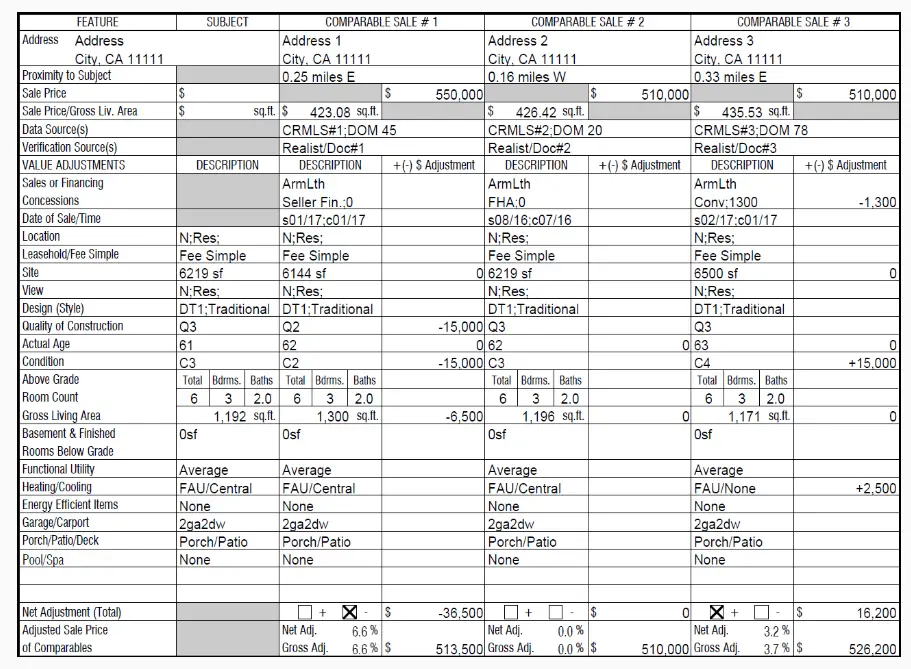
A practical example of choosing between three sales
This example is hypothetical and does not describe a Capital Valuations assignment or establish local adjustment rates. Assume the subject is a 2,000-square-foot detached home with an attached garage, typical updates, and no water view.
| Candidate sale | Selection question |
|---|---|
| Sale A: nearby, similar size and condition, closed four months ago | A promising candidate. Verify the terms, relevant property details, and market timing. |
| Sale B: next door, substantially larger, extensively renovated, with a water view | Proximity is a strength, but several important differences may limit its usefulness. |
| Sale C: farther away, similar design and condition, closed recently | Investigate whether its location competes with the subject and whether a location adjustment is supported. |
Sale A may offer the most direct comparison. Sale C could help if its location is competitive and its data are reliable. Sale B might provide context or evidence about a feature, but being next door does not erase its differences. The final selection follows the research, not the order of prices in a search result.
Why appraisers use more than one comparable
One transaction rarely answers every question. Several sales let the appraiser test whether an apparent pattern holds across different properties. Where the market permits, sales with features above and below the subject can help show how it fits within the available evidence. This is often called bracketing.
Bracketing is more useful when it concerns meaningful characteristics, such as living area or condition, than when it simply places a target price between a high sale and a low sale. A set of sales should make sense as a group and as individual comparisons.
After selection, the appraiser analyzes supported adjustments and decides which indications deserve the most weight. The lowest adjustment total does not automatically win, and the conclusion is not necessarily an average. Our guide to appraisal reconciliation explains that next step.
What happens when there are very few good comps?
An unusual property or low-turnover market may require older sales, a broader competitive area, or properties with more differences. The report should explain those choices and the limits of the evidence. Expanding the search is useful only when the additional sales help answer the valuation question.
For the detailed discussion of these tradeoffs, read what appraisers do when a home has very few comparable sales.
How homeowners and agents can suggest useful sales
You can provide sales you believe the appraiser should consider. A short explanation of the similarities is more helpful than a list selected only because the prices are high.
- Identify the property and closing date. Include a listing reference or other source if available.
- Explain why it competes. Point to similar location, design, size, overall condition, lot utility, or other relevant features.
- Acknowledge important differences. A renovated waterfront home needs more explanation when the subject has neither feature.
- Share records for the subject. Dated improvement details, permits, plans, surveys, and relevant association information can resolve misunderstandings.
The appraiser independently evaluates the information and may select different sales for supported reasons. If a completed lender appraisal contains a specific factual error or appears to omit relevant evidence, ask the lender about its reconsideration of value process.
For an independent residential appraisal in Hampton Roads, contact Joe at Capital Valuations with the property address, intended use, and date the value needs to address. Those details help define the assignment and the evidence it will require.